The great change in poster art, after WWII was the increasing use of photography. This, in addition to the growth of offset lithography, enabled companies to spread their gospel more efficiently and at lower costs. In addition, utilization of photographs made the creative process faster, as well as inviting graphic elements into the mix.
A perfect example of this would be the Porsche Factory’s 1955 Tourist Trophy created by Erich Strenger. From my perspective, he is the single greatest poster artist of this era. If one looks at his output from the 1950s into the 1980s, you will see the absolute evolution of poster design.
In the 1950s many posters were done by artists to set the scene as desired via the art itself. This is a continuation of the Pre-War art approach, which produced some truly sensational images. Among them are the event posters for the 1954 Carrera Panamericana, 1956 Mille Miglia, the 1958 Nürburgring motorcycle race, and the 1959 Sebring.
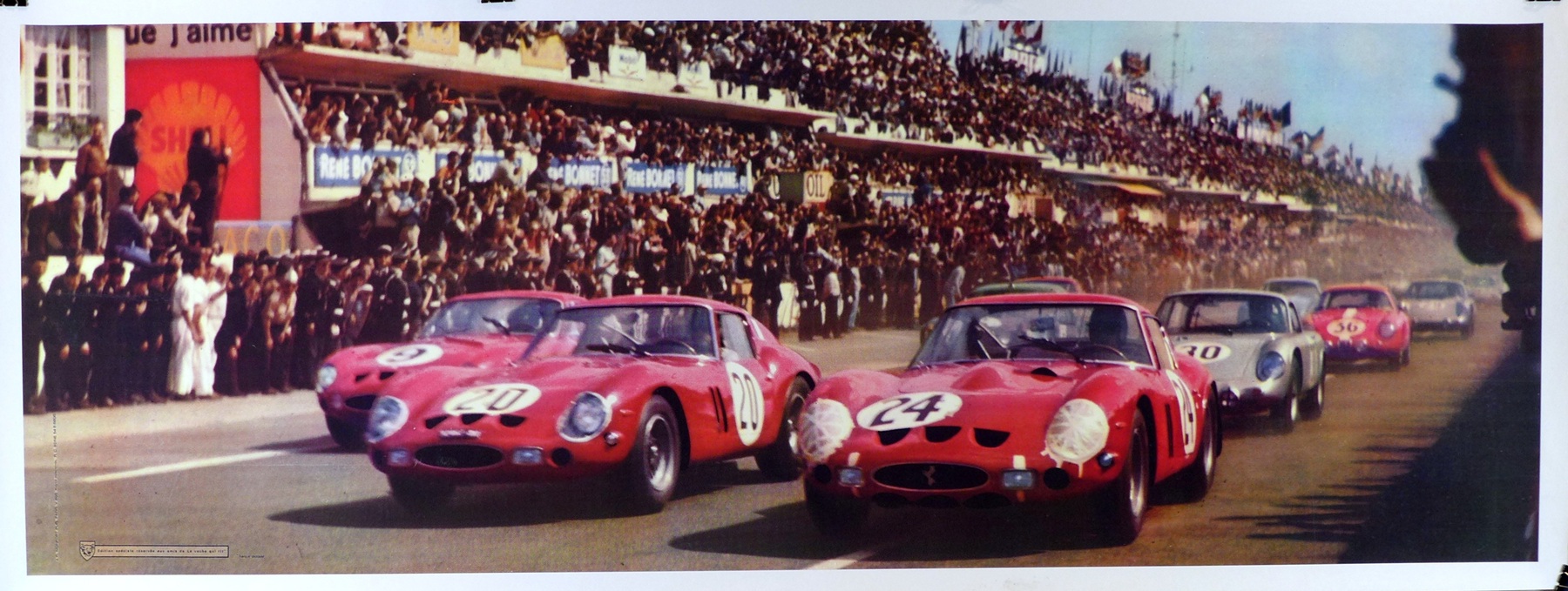
The dominance of the photo, itself, is more evident in the 1960s with Porsche’s 911S, the 1963 Le Mans start from La Vache Qui Rit, the Mercedes showroom 230-SL, and the Mini.
As with all “collectibles,” one should be buying because the piece resonates with you and is something you love. Think of it this way: you are going to be seeing this with frequency, so the piece should bring you joy, not regret. To buy for “investment” is missing the entire point, as the appreciation and ownership is its own reward that cannot be measured in dollars.